


Urasenke vs. Omotesenke
- tanjaschneider96
- May 2
- 2 min read
The Secret of Chawan Proportions
Anyone diving deeper into the Way of Tea (Chado) soon realizes: it is often the tiniest details that define a school's character. A frequently discussed topic is the size and shape of the Chawan (tea bowl). It is often said that Urasenke bowls differ from those of Omotesenke—but why is that, and why is it sometimes so difficult even for experts to tell them apart?






The Legend of the "Master’s Hands"
A particularly fascinating explanation often arises in conversations with potters in Japan. It is said that the physical stature of the early generations significantly shaped the preferences of the schools.
Specifically regarding Omotesenke, there is a long-standing oral tradition that the early heads of the school (Iemoto) often had a more robust build and larger hands. When a master commissioned a bowl from a potter, it was crafted to fit perfectly into his palms. Because students over the centuries emulated the aesthetics of their masters to honor them, these "robust" proportions established themselves as an ideal. In this way, the bowl becomes almost an extension of the ancestors' reach.
Different Paths to the Perfect Tea
Beyond anatomy, the method of tea preparation naturally plays a role:
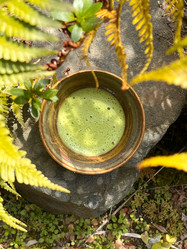
Urasenke: Known for its dense, "mountain-like" froth, Urasenke often utilizes bowls with a bit more room and slightly higher walls. This gives the whisk (Chasen) the necessary space for the vigorous movements required to create that signature foam.
Omotesenke: Here, a small area of the surface is left free of foam (resembling a lake). The bowls often appear a bit more compact or grounded in their form, which beautifully complements their more conservative, tradition-conscious aesthetic.
Why the Difference Exists: Aesthetics and Philosophy
The reason lies in the historical development of the schools following the era of Sen no Rikyu:
Omotesenke is considered the guardian of tradition. Its aesthetic is often more conservative and remains closely aligned with the classic ideals of simplicity and frugality (Wabi). The bowls are intended to be modest and functional, without imposing themselves.
Urasenke has developed more progressively over the centuries. In this school, the bowls are often allowed to be more decorative or striking in their form; this is sometimes reflected in a slightly larger stature to provide the guest with a more opulent experience.
Why Is It So Hard to Distinguish Them?
Despite these tendencies, identifying a bowl is not an exact science, for several good reasons:
No Standardized Measurements: A potter follows their own artistic vision first. A bowl can be suitable for both schools as long as its "spirit" aligns with the practice.
Seasonal Variance: In summer, both schools use shallow Natsu-chawan, and in winter, deep Tsutsu-chawan. These seasonal differences are often far more pronounced than the differences between the schools themselves.
The "Konomi" Tradition: Many bowls are Konomi—meaning they represent the personal taste of a specific master from a specific era. This creates immense variety even within a single school.
Conclusion
Whether a bowl is "Urasenke" or "Omotesenke" is often decided not by a ruler, but by the feeling of holding it. When you cradle a bowl in your hands, you might sense exactly what the potter meant: the presence and history of those who designed them hundreds of years ago.


Comments